


Guide to some common
copepods in the
Benguela Current LME
Zooplankton Workshop
Swakopmund, Namibia
January 2007
Compiled by:
Jenny Huggett (MCM, DEAT) &
Janet Bradford-Grieve (NIWA)
Foreword
Zooplankton occupy a key position in the pelagic foodweb, as they transfer organic energy
produced by phytoplankton to higher trophic levels, including pelagic fish. In the coastal upwelling
region of the Benguela Current Large Marine Ecosystem (BCLME) off southern Africa, data on
zooplankton have been collected routinely, primarily in support of fisheries research, since the
development of the pelagic fishing industry in southern Africa in the early 1950s. Zooplankton
monitoring is ongoing in the region, and even if only the biomass distribution is usually investigated
by applying bulk methods like volume or weight measurements, inspection of the species
composition adds valuable information on the relative abundance, distribution and diversity of taxa.
However, the BCLME region in general, and South Africa in particular, have over the past 2
decades suffered an enormous loss of expertise in zooplankton taxonomy at an exponential rate,
to the extent that the very few experts remaining are on the list of `Endangered Species'.
Furthermore, such expertise has still to be developed in Namibia and Angola.
The dwindling of zooplankton taxonomic expertise over the years has restricted local scientists in
their ability to study changes in zooplankton community structure in detail. Such knowledge is
essential to understand and be able to predict the impact of environmental changes on fish stock
fluctuations. In addition to the harvesting of marine living resources, the region is a hub of maritime
activities, including oil and gas exploration and production, diamond mining, shipping, ports, and
sovereignty and resource protection. The impacts of these activities on ecosystem health require
judicious management at the ecosystem level, and the Benguela Current Commission (BCC) was
recently established for that purpose. Detailed zooplankton taxonomic analyses will provide the
BCC with practical applications to a range of policy issues such as climate change, biodiversity,
the introduction of alien species, pollution and eutrophication in addition to fisheries.
To address this situation, a regional training course in zooplankton taxonomy and species
identification was developed to upgrade institutional capacity in the BCLME region. Funds were
sourced from the 2 regional capacity building programmes, BENEFIT and BCLME, as well as the
Alfred P. Sloan Foundation (USA) through the Census of Marine Zooplankton, a project of the
global Census of Marine Life. The course was facilitated by Dr Janet Bradford-Grieve, FRSNZ and
world authority on copepod taxonomy from New Zealand. Five scientists and technicians from
each of the 3 countries bordering the Benguela Current, viz. Angola, Namibia and South Africa,
participated.
The course was held in Swakopmund, Namibia, during the period 8-19 January 2007. Practical
sessions on taxonomy and microscope identification of different zooplankton groups were
interspersed with lectures on the Benguela Current Ecosystem (Anja Kreiner, NatMIRC/MFMR),
zooplankton ecology (Jenny Huggett, MCM/DEAT), sampling methodology and sample analysis
(Hans Verheye, MCM/DEAT), copepod morphology, using keys, and copepod dissection and
observation (Janet Bradford-Grieve). Material used for analysis included samples collected from
the 3 respective countries.
This guide to common copepods was compiled during the workshop as an informal and useful
take-home tool for the participants. It highlights some of the key features used to distinguish some
of the more abundant copepod genera and species in the region, drawing on a number of more
comprehensive references listed at the end of this guide. It is by no means comprehensive and is
intended to serve as a basis for further laboratory-based learning in each BCLME country. It is also
envisioned as the first in a series of identification guides to other taxa examined during the
workshop, including euphausiids, amphipods and chaetognaths, and important taxa not covered
during the workshop, such as gelatinous zooplankton (jellyfish, ctenophores, appendicularians,
salps, doliolids).
Course Convenors: Hans M. Verheye (MCM/DEAT) and Anja Kreiner (NatMIRC/MFMR)
2
Index
Page
Copepod form ventral view
4
Copepod form lateral view
5
Calanoid mouthparts
6
Calanoid mouthparts and swimming leg
7
Major body articulation
8
Calanoida:
9
Family Calanidae
9
Calanoides cf carinatus
10
Calanus agulhensis
11
Calanus agulhensis males vs Calanoides cf carinatus males
12
Mesocalanus tenuicornis
13
Nannocalanus minor
14
Neocalanus gracilis
15
Neocalanus tonsus
16
Undinula vulgaris
17
Family Paracalanidae
18
Calocalanus namibiensis
19
Calocalanus pavo
20
Calocalanus plumulosus
20
Paracalanus parvus
21
Parvocalanus crassirostris
22
Parvocalanus scotti
22
Family Mecynoceridae
23
Mecynocera clausi
23
Family Eucalanidae
24
Eucalanus hyalinus sl
25
Subeucalanus pileatus
26
Pareucalanus sewelli
27
Rhincalanus nasutus
28
Family Clausocalanidae
29
Clausocalanus furcatus
30
Ctenocalanus vanus
31
Ctenocalanus cf citer
31
Small copepods P5 comparison
32
Family Aetideidae
33
Aetideus armatus
33
Family Euchaetidae
34
Euchaeta marina
34
Family Lucicutiidae
35
Lucicutia flavicornis
35
Family Metridinidae
36
Metridia lucens
36
Pleuromamma abdominalis
36
Family Centropagidae
37
Centropages brachiatus
37
Family Candaciidae
38
Candacia bipinnata
38
Poeicilostomatoida:
39
Family Oncaeidae
39
Oncaea mediterranea
39
Some other Poeicilostomatoida
40
Cyclopoida:
41
Family Oithonidae
41
Harpacticoida
42
Glossary
43
References
44
3
Copepod form ventral view
4
Copepod form lateral view
(Ro)
Mxp1*
Mxp2*
(Ur4)
(CR)
* used by some older works
5
Calanoid mouthparts
Antennule (A1)
Antenna (A2)
Enp2
Exp3
Enp1
Exp2
Exp1
B
C
Maximum 28 segments in female A1
Mandible (Md)
Maxillule (Mx1)
Exp4
Le1
Mdp
Pc
Exp1
C
Le2
Enp1
B
Li4
Exp
Li1
Li2
Li3
Gn
Li = Inner lobe (endite)
Enp1-3
Le = Outer lobe (epipodite)
6
Calanoid mouthparts and swimming leg
Maxilla (Mx2)
Maxilliped (Mxp)
Enp
Li3
Enp2
Enp3
Li6
Enp1
Li5
Li1
B
Li2
Li4
C
Structure of calanoid swimming leg
C
B
Exp1
Enp1
Enp2
Exp2
Enp3
Exp3
7
Major body articulation
Cyclopoida
Harpacticoida
Calanoida
Poecilostomatoida
Cyclopoida
Poecilostomatoida Harpacticoida
Calanoida
8
Calanoida: Family Calanidae
Family Calanidae
Genera: Calanoides, Calanus, Canthocalanus, Cosmocalanus, Mesocalanus,
Nannocalanus, Neocalanus, Undinula
Females:
Ce and Pd 1 may be fused or separate. Pd4 and 5 always separate. Ur 4-
segmented. P5 similar to P2-4. P5 Coxa with inner edge teeth in Calanus,
Nannocalanus and Cosmocalanus.
Males:
Ur 5-segmented. P1-4 as in female. P5 with both rami usually 3-segmented,
right leg similar to other P, left leg variously modified. Enp sometimes
reduced and devoid of setae on one or both sides.
9
Calanoides cf. carinatus
Females 2.25 - 2.85 mm; Males 2.35 2.70 mm
pointed head
rounded head
segments
2 & 3
fused
5th legs of
similar length
Spermatheca long in lateral view
Male 5th legs of
similar length
NO setae
on outer
border of
Left Endopod
Right Enp3
reduced/vestigial
P5 inner coxa without teeth
10
Calanus agulhensis
Females 2.45 - 2.95 mm; Males 2.74 - 3.00 mm
segments
2 & 3 not
fused
right P5 approx. 1.5 - 1.6
times shorter than left P5
Teeth on
inner edge
of coxa
11
Calanus agulhensis males vs. Calanoides cf carinatus males
TL = 2.72 mm - West Coast of SA
TL = 2.16 mm - Agulhas Bank (SA)
TL = 2.55 mm Agulhas Bank (SA)
TL = 2.42 mm (2.08-2.60) Ivory Coast
TL = 2.3 mm (2.2-2.5) Conway et al. 2006
Calanus is usually bigger than Calanoides, but there is a size overlap, so length not definitive
rounded head
rounded head, not pointed as in female
A1: 2nd & 3rd
segments NOT
A1: 2nd & 3rd
fused
segments
fused
Male P5 (5th swimming leg)
Legs quite different lengths:
Distal end of Rt Exp 3 only
Legs similar in length:
extends ~midway up Left Exp2
Distal end of Rt Exp 3
overlaps with Left Exp3
NO
setae
setae (usually 2) on outer
on outer border
border
Left Endopod
of both Enp3
of Right
reduced/vestigial
Enp3
Teeth on
inner edge
NO teeth on
of coxa
inner edge
of coxa
12
Mesocalanus tenuicornis
Females 1.80 - 2.40 mm; Males 1.70 2.20 mm
Long antennule
Long CR
Female P5
Male P5
P5 Endopods
P5
P5
with 7 setae
each
P5 inner coxa without teeth
13
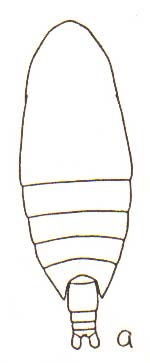
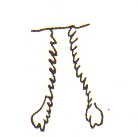
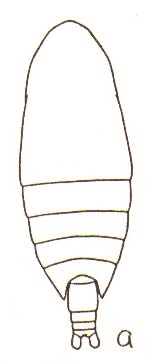
Nannocalanus minor
Females 1.80 - 2.25 mm; Males 1.20 1.80 mm
Ce and
Pd1
fused
note teeth
In dorsal view, note that posterior
As with Calanus, the inner sides of the
margin of metasome extends into two
coxa on the 5th swimming legs (both male
points, giving it a "notched" look
and female) are lined with small teeth.
Additional note: Margins of segments on
prosome often have red colouration.
14
Neocalanus gracilis
Females 2.43 4.00 mm; Males 2.30 3.10 mm
Short CR cf
Mesocalanus
tenuicornis
setae present on
inner border of
Exp 3 (also in N.
Female with long A1
robustior) not
seen in other Male
Calanidae
8 setae on Endopod
(cf 7 on M. tenuicornis)
P5
P2
setae on inner
P1
border of Exp 3
found in all Female
Calanidae
Neocalanus feature:
P2 Exp 1 with recurved
spine (hook) adjacent to
outer spine
15
Neocalanus tonsus
Females 3.40 4.10 mm; Males 3.30 4.40 mm
Only
Neocalanus
tonsus has
postero-distal
inner spines on
Basis of P2-4
swollen Gns (in
dorsal view)
compared to other
Calanids
P2
P5
Neocalanus feature:
P2 Exp 1 with recurved
spine (hook) adjacent to
outer spine
16
Undinula vulgaris
Females 2.25 3.25 mm; Males 2.04 2.50 mm
Ce and Pd1
fused
Posterior corners
of Pr pointed
Male P5 highly
modified
Female (and Male) P2
Exp 2 with outer
proximal edge
invaginate
P5 inner coxa without teeth
17
Calanoida: Family Paracalanidae
Family Paracalanidae
Genera: Acrocalanus, Bestiolina (not recorded in the South Atlantic),
Calocalanus, Delius, Paracalanus, Parvocalanus
Females:
Ce and Pd 1 usually fused. Pd4 and 5 fused or separate. Ur 2-4-segmented.
Anal somite usually longer than any somite between it and Gns. R of 2
filaments (Acrocalanus, Calocalanus, Paracalanus); 2-pointed, solid (Delius);
or massive (Parvocalanus). P5 uniramous, absent or vestigial (Acrocalanus),
present on left only (Delius). If both P5 present then symmetrical, 2-
segmented (or 3-segmented) (Paracalanus, Parvocalanus) or 3-4-segmented
(Calocalanus).
Males:
A2 terminal Exp(7) very short and without 3 terminal setae (as seen in
females). Ur 5-segmented. Cephalic hump present (Acrocalanus,
Paracalanus) or absent. Right P5 may be absent (Acrocalanus, Delius), or
present as 2-3-segmented (Paracalanus, Parvocalanus), or 3-4-segmented
(Calocalanus).
Calocalanus
Female P5 3-4-segmented
Male Right P5 4-segmented
18
Calocalanus namibiensis
Females 0.66 0.70 mm; Males 0.50 0.52 mm
* Short Ur with fat, onion-shaped Gns is
characteristic of Calocalanus females
Male P5 extends
slightly beyond CR
(not shown here)
*
Ur with 3 somites
Ur with 5 somites
(in all Paracalanid males)
Characters used to identify
Calocalanus females to species:
- Ur somites (2, 3 or 4 one somite
may be difficult to see due to
P2
P4
telescoping within previous segment)
- P5 terminal setae/spines
- CR symmetry
P1
Terminal segment
with 1 setal element
P5 4-segmented.
19
Calocalanus pavo
Females 0.88 1.20 mm; Males 0.91 1.04 mm
Right P5 leg does not extend as far as
distal border of segment 2 of left leg
TL>0.8 mm
Female P5
Female Ur with 2 somites
Male P5
Calocalanus plumulosus
Females 0.93 1.20 mm; Males 0.83 0.90 mm
Right P5 leg extends beyond
segment 2 of left leg
Male P5
TL>0.8 mm
3 setal elements
Female Urosome
4 segments
3 somites
CR asymmetrical
Female P5
Female P4
20
Paracalanus parvus
Females 0.70 1.30 mm; Males 0.74 1.40 mm
Many fused and swollen
segments in Male A1
Ce and
Pd1 fused
A1 extends
to posterior
border of Ur3
relatively
(not shown)
long Ur4
(in males too, cf
Clausocalanus)
Anal somite (Ur4)
longer than Ur3
and Ur2.
Female Urosome:
Gns with angular projection
ventrally, cf more rounded
shape in Clausocalanidae
Right P5 does not
extend as far as distal
border of left leg
segment 2
Male P5
Female P5
21
Parvocalanus crassirostris
Females 0.47 0.55 mm; Males 0.35 0.39 mm
P5 terminal segment just under 0.5
times as wide as long with 2
subequal strong terminal spines
Female P5
Female P1 with 2-segmented
Male P5
Enp (not shown)
Parvocalanus scotti
Females 0.64 0.67 mm; Males unknown
P5 terminal segment about 0.3 times
as wide as long with inner terminal
spine longest.
P5
P1: 1-segmented Enp
P1
P2
P4
P3
Female legs:
22
Calanoida: Family Mecynoceridae
Mecynocera clausi
Females 0.92 1.21 mm; Males 0.94 1.12 mm
Female has very long A1 but
small body size
Female has globular Gns with obvious spermathecae
23
Calanoida: Family Eucalanidae
Family Eucalanidae
Large copepods with elongated and transparent bodies. In dorsal view, most
have a typical triangular anterior cephalosome.
Genera: Eucalanus, Pareucalanus, Subeucalanus, Rhincalanus
Females:
Ce & Pd1 fused; Pd4 & 5 partially fused. Urosome very short, 3- or 4-
segmented. Genital segment usually broad. CR usually fused to anal somite.
P5 absent in Eucalanus, Pareucalanus & Subeucalanus. P5 with 3 segments
in Rhincalanus
Males:
Ur 5-segmented. CR usually fused to anal somite. P5 uniramous both sides
(Eucalanus, Pareucalanus), biramous on left (Rhincalanus) or absent on right
(Subeucalanus).
24
Eucalanus hyalinus s.l.
Females 5.10 7.10 mm; Males 4.70 6.25 mm
Very Big Copepod!
Female rostrum
L&R A1 of
different lengths
(not shown)
Ur with 3 free somites (Ur4 fused with
CR) = characteristic of Eucalanus
Enp reduced; B
and Exp elongate
To identify E. hyalinus vs. E. spinifer:
(feature of all
Enp
1.
Measure total length
Eucalanidae except
2.
If prosome < 6.2 mm, then...
Rhincalanus)
3.
Measure lengths of antennule ancestral seg
22 (actual seg 18) on both sides. Calculate
B
ratio of long/short segments: E. hyalinus =
1.35-1.59; E. spinifer = 1.18-1.33 (see
Female Mandibular palp
Goetze & Bradford-Grieve 2005)
P1
Female P1 with seta on Basis
(feature of Eucalanidae)
Male P5
Female Urosome
3 free somites
Uniramous on both sides
(Eucalanus & Pareucalanus)
25
Subeucalanus pileatus
Females 1.95 2.50 mm; Males 1.80 2.25 mm
Male Ce
In lateral view, distal part of
seminal receptacles bilobed
specific to S. pileatus
Ur with 2 free somites (Ur3 fused with
CR) = characteristic of Subeucalanus
and Pareucalanus
Female Gns
[S. longiceps A2]
Enp
Exp
Right P5 absent
= characteristic
of Subeucalanus
A2 Exp segments 1-4 fused. (Fusion of
Exp1 & 2 = characteristic of Subeucalanus)
Male P5
26
Pareucalanus sewelli
Females 3.86 6.10 mm; Males 2.89 4.58 mm
Ur with 2 free somites (Ur3 fused with
Female urosome
Male urosome
CR) = characteristic of Subeucalanus
and Pareucalanus
A2 Exp segments 2-4 fused.
Enp1 & 2 not fused (not
shown) cf Subeucalanus
B
Mdp Basis with 2
setae (specific to
P. sewelli)
Male P5 = uniramous on both
Female Mandibular Palp (Mdp)
sides (also in Eucalanus). Right
P5 is 3-segmented.
27
Rhincalanus nasutus
Females 3.90 5.30 mm; Males 2.70 4.30 mm
Female Ur 2-segmented
Female Mandibular Palp (Mdp)
Urosome
P5
P1
L
P5
R
P5 present in
female, and is 3-
Male P5 biramous on left
segmented
28
Calanoida: Family Clausocalanidae
Family Clausocalanidae
Anal segment usually short relative to Gns, sometimes telescoped inside
previous segment in the males. At least 6 genera,with Clausocalanus,
Ctenocalanus, Drepanopus and Farrania found in the South Atlantic.
Microcalanus, Pseudocalanus and Spicipes not yet recorded in S.
Atlantic. The genus Clausocalanus was revised by Frost & Fleminger
(1968).
Clausocalanus:
Females: P5 uniramous on both sides, symmetrical, 3-segmented
terminally produced into short bifid pointed processes. Males: P5 present
on both sides, but unequal in length, uniramous. Longer leg nearly
always on left, 5-segmented; shorter leg 3-segmented, less than half
length of Coxa of other leg.
Ctenocalanus:
Females: P5 consisting of very small appendage, developed only on the
left and of 2-4 segments. Males: P5 as in Clausocalanus.
29
Clausocalanus furcatus
Females 0.94 1.31 mm; Males 0.70 0.92 mm
spermatophore
does not extend
anteriorly to
articulation of
Gns
P1 with P2
Ur3
Gns relatively
short cf other
Clausocalanus
spp, being similar
Longest P5 (usually right leg)
in length to Ur3
longer than Urosome
Female Gs
Female P5
Male P5
30
Ctenocalanus vanus
Females 0.92 1.16 mm; Males 1.20 1.26 mm
A1 reaches posterior border of CR
curved section of antennule
A1 bends slightly after long fused section
Male P5
Male P3 basis
Female P4
P4 Exp2-3 (part)
Right P5
short stump
Female Gns
Female P5
Female P4 Exp3 outer
spines robust, expanded
at the base
Ctenocalanus citer
Females 0.80 1.41 mm; Males 0.99 1.45 mm
A1 exceeds CR by several segments
Male P5
Female P4 Exp3 outer spines not expanded
at the base
31
Small copepods P5 comparison
Clausocalanidae
Clausocalanus spp.
Female Ur4 usually relatively short.
Female: P5 uniramous on both sides,
symmetrical, 3-segmented terminally
produced into short bifid pointed
processes.
Male: Both P5 present, uniramous. Left leg
C. pergens
5-segmented, much longer than 1-3-
segmented right leg. Right P5 with terminal
spinules on distal segment.
Ctenocalanus vanus
Female Ur4 similar in length to Ur3.
Female: P5 consisting of very small
appendage, developed only on the left and
of 2-4 segments.
Male: P5 present on both sides, uniramous.
Long leg 5-segmented, right leg short
stump lacking spines and spinules.
C. vanus C. citer
Paracalanidae
Female Ur4 usually relatively long
Paracalanus parvus
Female: Both P5 developed, symmetrical 2-
segmented.
Male: Long 5-segmented left leg. Right P5
2-segmented, does not reach distal border
of left leg segment 2
Parvocalanus crassirostris
Female: P5 2-segmented
Male: Long 5-segmented left leg. Right P5
2-segmented, does not reach distal border
of left leg segment 1
Acrocalanus spp. (not shown)
Female: P5 absent or vestigial
Male: Right P5 absent, or 1-segmented
32
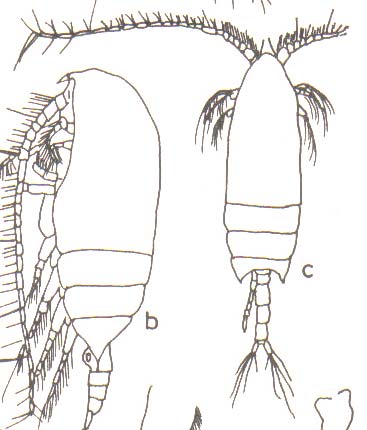
Calanoida: Family Aetideidae
Aetideus armatus
Females 1.60 2.00 mm; Males 1.30 1.53 mm
Female has prominent bifurcated
rostrum
no rostrum in male
Ce and Pd1 fused
Pd4 & 5 fused;
terminal prosome
no P5
points shorter than
in female
posterior corners of
prosome extend into
5th Ur segment
long, sharp points
very small
Male left P5 uniramous, elongated, simple,
with 5 segments; right P5 absent
Lateral view of female genital segment
33
Calanoida: Family Euchaetidae
Single rostral point
Very large Maxillipeds
Pareuchaeta sp.
RR
L
Long appendicular
seta on ventral
surface, sometimes
curved
In all Euchaetidae: Male P5 basis swollen on both legs; Left Basis
larger than Right Basis. Right Exp with 2 elongated segments, Left
Exp with one segment
Euchaeta marina
Characteristic
feature of Male
Females 3.40 3.64 mm; Males 2.88 3.20 mm
Euchaeta:
Distal Exp
segment on both
right and left P5
tapering into long
left Exp 2 with
spine
serrated lamella
Female Gns distinctive shape,
asymmetrical with rounded
Terminal part of Male Left P5
protrusion, triangular in dorsal view
34
Calanoida: Family Lucicutiidae
General form of
Lucicutia
Female: Elongated Urosome.
CR symmetrical, relatively long,
with 7 setae
Female P5 Exp2 with inner seta
thickened into a strong spine.
Male P5 basis with inner extensions
Lucicutia flavicornis
Females 1.30 2.00 mm
Males 1.30 1.70 mm
Female Urosome
Male P5
35
Calanoida: Family Metridinidae
Females:
Ce & Pd1 separate. Ur of 3
somites. Pd1 with dark
pigmented spot on one side in
Pleuromamma. Enp segment 1
*
of P2 typically incised and
ornamented with 1 or more
hook-like spinous processes.
Males:
Ur of 5 somites. A1 prehensile
on one side only (usually left).
P5 asymmetrical. Left P5 Exp 1
with curved inner process, distal
segment swollen, often curved
or claw-like.
Metridia lucens
Pleuromamma abdominalis
Females 2.39 2.93 mm; Males 1.62 2.30 mm Females 2.40 3.70 mm; Males 2.75 3.50 mm
Female Gns
*Has distinctive sloping head of Metridia
in lateral view. Also distinctive long,
narrow Urosome.
Male P5
Female P5
Male P5
36
Calanoida: Family Centropagidae
General form of
Centropages
Centropages brachiatus
Females 1.73 2.30 mm; Males 1.58 1.90 mm
Female Ur, ventral view
Female P5
Male right A1
Male P5
37
Calanoida: Family Candaciidae
General form of
Candacia
square head
Body relatively robust, anterior
Ce rectangular in dorsal view,
with conspicuous lateral
constriction anteriorly (square
head). Many spp have dark
pigment in some parts of body.
Prosome ends in pointed
processes, often asymmetrical.
Candacia bipinnata
Females 2.35 2.65 mm; Males 2.15 2.50 mm
Male Genital segment
Female Urosome
right process with blunt end, extends
below Gns)
lamella on ventral surface of Ur2
triangular, pointed lateral margins
38
Poeicilostomatoida: Family Oncaeidae
Oncaea mediterranea
Females 1.14 1.26 mm; Males 0.74 0.97 mm
Female Maxilliped
Male Maxilliped
Female P4
Female Urosome
b
b<2a
Female P5
a
Enp 3 has
c=d
1 inner seta
d
and 2 outer
P5 terminal setae
spines
c
unequal in length
39
Some other Poeicilostomatoida
Lubbockia aculeata
Copilia hendorffi
Females 2.21 2.30 mm; Males 2.35 mm
Females 3.90 5.10 mm; Males 5.50 8.30 mm
Corycaeus agilis
Sapphirina opalina-darwinii
Females 0.92 0.98 mm; Males 0.70 0.77 mm Females 2.13 4.17 mm; Males 2.42 4.36 mm
40
Cyclopoida: Family Oithonidae
Oithona similis
Oithona plumifera
Females 0.68 0.96 mm; Males 0.67 0.70 mm Females 1.06 1.51 mm; Males 0.59 0.68 mm
Oithona atlantica
Oithona minuta
Females 1.00 1.43 mm; Males 0.82 mm
Females 0.45 0.65 mm; Males 0.42 0.50 mm
P1
P2
P4
P3
41
Harpacticoida
Clytemnestra scutellata
Euterpina acutifrons
Females 1.00 1.24 mm; Males 1.05 1.30 mm Females 0.50 0.75 mm; Males 0.50 0.56 mm
Clytemnestra rostrata
Macrosetella gracilis
Females 0.60 1.00 mm; Males 0.80 0.90 mm Females 1.40 1.50 mm; Males 1.13 1.16 mm
Microsetella norvegica
Microsetella rosea
Females 0.35 0.53 mm; Males 0.33 0.42 mm
Females 0.64 0.85 mm; Males unknown?
42
Glossary
Technical word
English
Portuguese
pedigerous
with legs
com patas
somite
body segment
corpo segmentado
seta(e)
articulated spine or hair-
espinha (pelo) articulado
like structure
que sai do segmento
truncate
chopped off
truncado
dorsal
top side (back)
dorsal
ventral
underside (tummy)
ventral
anterior
towards/in front
anterior
posterior
towards rear
posterior
ramus (i)
branch
ramificar
biramous
two branches
ramificado em duas partes
distal
away from point of origin
distante
proximal
close to point of origin
proximo
endo-
inside
interior
exo-
outside
exterior
blade
blade (flattened)
lamina
symmetrical
same both sides
simétrico
asymmetrical
not same both sides
assimétrico
vestigial
not well-developed
vestigio
protrusions
things sticking out
saliência do corpo
bifid
divided by a deep cleft
dividido em duas partes
into 2 parts
com uma fenda no meio
denticle
small tooth-like
pequena espinha (pelo)
projection
pectinate
toothed like a comb
saliências tipo serra
43
References
BOLTOVSKOY, D. (Ed.) 2005 - Zooplankton of the South Atlantic Ocean. A taxonomic
reference work with identification guides and spatial distribution patterns. DVD-
ROM. World Biodiversity Database Compact Disc Series. ETI Bioinformatics,
Multimedia Interactive Software. www.eti.uva.nl
BRADFORD-GRIEVE, J.M., MARKHASEVA, E.L., ROCHA, C.E.F. and B. ABIAHY
1999 - Copepoda. In: Boltovskoy, D. (Ed). South Atlantic Zooplankton, Vol. 2, p.
869-1098, Backhuys Publishers, Leiden, Netherlands.
BRADFORD-GRIEVE, J.M. 1994 - The Marine Fauna of New Zealand: Pelagic Calanoid
Copepoda: Megacalanidae, Calanidae, Paracalanidae, Mecynoceridae, Eucalanidae,
Spinocalanidae, Clausocalanidae. Mem. New Zealand Oceanogr. Inst. 102: 1-160.
BRADFORD-GRIEVE, J.M. 1999 - The Marine Fauna of New Zealand: Pelagic Calanoid
Copepoda: Bathypontidae, Arietellidae, Augaptilidae, Heterorhabdidae, Lucicutiidae,
Metridinidae, Phyllopodidae, Centropagidae, Pseudodiaptomidae, Temoridae,
Candaciidae, Pontellidae, Sulcanidae, Acartiidae, Tortanidae. Mem. New Zealand
Oceanogr. Inst. 111: 1-268.
CONWAY, D.V.P., WHITE, R.G., HUGUES-DIT-CILES, J., GALLIENNE, C.P. and D.B.
ROBINS 2003 Guide to the coastal and surface zooplankton of the south-western
Indian Ocean. Occas. Publ. Mar. Biol. Ass. U.K. 15, Plymouth, U.K.
DE DECKER, A.H.B., KACZMARUK, B.Z. and G. MARSKA 1991 - A new species of
Calanus (Copepoda, Calanoida) from South African waters. Ann. S. Afr. Mus. 101(3):
27-44.
FROST, B.W. and A. FLEMINGER 1968 - A revision of the genus Clausocalanus
(Copepoda: Calanoida) with remarks on the distributional patterns in diagnostic
characters. Bull. Scripps Inst. Oceanogr. Tech. Ser. 12: 1-99.
GOETZ, E. and J. BRADFORD-GRIEVE 2005 Genetic and morphological description of
Eucalanus spinifer T. Scott, 1894 (Calanoida: Eucalanidae), a circumglobal sister
species of the copepod E. hyalinus s.s. (Claus, 1866). Prog. Oceanogr. 65: 55-87
HUYS, R. and G. BOXSHALL 1991 - Copepod Evolution. Ray Soc. Publ. 159, London, pp.
1-468.
PARK, T. 1995 - Taxonomy and distribution of the marine calanoid copepod family
Euchaetidae. Bull. Scripps Inst. Oceanogr. 29: 1-203.
44